Mummification in ancient Egypt was a seventy-day promise that the dead would live again
Mummification in ancient Egypt was a seventy-day promise that the dead would live again
Mummification in ancient Egypt was the practical side of a belief: the soul needed a recognizable body to come home to, so the body had to be kept from rotting. Over roughly seventy days, embalmers washed the corpse, drew the brain out through the nose, moved the lungs, liver, stomach and intestines into four canopic jars, and buried the body in natron salt until it was bone dry. The heart stayed in place, because it would be weighed against a feather in the afterlife. Then came resins, linen, amulets and a mask. Today you can stand in front of the results in Cairo, Luxor and the Valley of the Kings, and this guide tells you how it worked and how to see it well.
Why the Egyptians mummified their dead
Nothing about mummification makes sense until you know what an Egyptian thought a person was. You were a body, a name, a shadow, and two spiritual parts that mattered enormously after death: the ka and the ba.
The ka was your life force, which still needed food and drink after death, which is why tombs are full of offering tables and painted bread. The ba was closer to personality, drawn as a bird with a human head. It flew out of the tomb by day, but every night it had to return to a body it could recognize. If that body had rotted, the person died a second, final death.
So the body was a house. Keep the house standing and the ka and ba could reunite in it, and the person became an akh, a transfigured spirit among the gods. Let it collapse and everything else was wasted. The earliest Egyptians, buried in shallow desert pits, got preservation for free from the hot sand; once the dead were laid in coffins inside cool tomb chambers, bodies decayed. Mummification is the Egyptians engineering a way to get back what the desert had once done on its own.
The seventy-day process, step by step
Our best written account comes from Herodotus, the Greek traveler who visited Egypt in the fifth century BC and described three grades of service, from deluxe down to a wash and a dry. Resin analysis and the embalmers' workshop found at Saqqara have confirmed his outline. The first-class version ran like this.
- Washing. The body went to a workshop on the west bank of the Nile and was washed with water and palm wine.
- Removing the brain. A long bronze hook went up the nostril, broke the thin bone behind the nose, and stirred the brain until it drained out. The Egyptians thought it useless and discarded it.
- Opening the flank. A short cut on the left side, made with a flint blade, let the embalmer remove the lungs, liver, stomach and intestines. The heart stayed in place.
- Treating the organs. The four organs were dried in natron, wrapped and placed in canopic jars.
- Drying in natron. The cavity was packed with bags of natron and the whole body covered in the salt for around forty days. This is the step that actually makes a mummy.
- Anointing and packing. The dark, shrunken body was rubbed with oils and warm resin and stuffed with linen or sawdust to restore its shape.
- Wrapping. Over the final two weeks priests wrapped each finger and toe, then the limbs, then the trunk, in hundreds of yards of linen, placing amulets at set points.
- Mask and coffin. A mask went over the head, the mummy went into nested coffins, and at the tomb door the Opening of the Mouth ritual gave the dead person back the power to eat and speak.
Seventy days was symbolic as much as practical: it is how long the star Sirius vanishes from the Egyptian sky before rising again with the Nile flood.
Natron and resins, and why the chemistry worked
Natron is a natural mixture of sodium carbonate, sodium bicarbonate and some common salt that crystallizes on the shores of seasonal lakes in the Wadi el Natrun, west of the Nile Delta. It pulls water out of tissue fast, and its alkalinity breaks down fat and stops bacteria multiplying. Forty days under natron leaves a body at a small fraction of its living weight, leathery and stable. Modern experiments with natron have produced results that look very much like the originals.
After drying, embalmers brushed skin and bandages with a hot mixture that laboratory analysis has identified: conifer resin from cedar or juniper, beeswax, plant oils, bitumen in later periods, and aromatics imported from Lebanon and the Aegean. These sealed the surface, killed microbes, and gave old mummies the dark gloss that made medieval Europeans think they were made of pitch, which is why the Arabic word for bitumen, mumiya, became our word mummy.
Canopic jars and the four sons of Horus
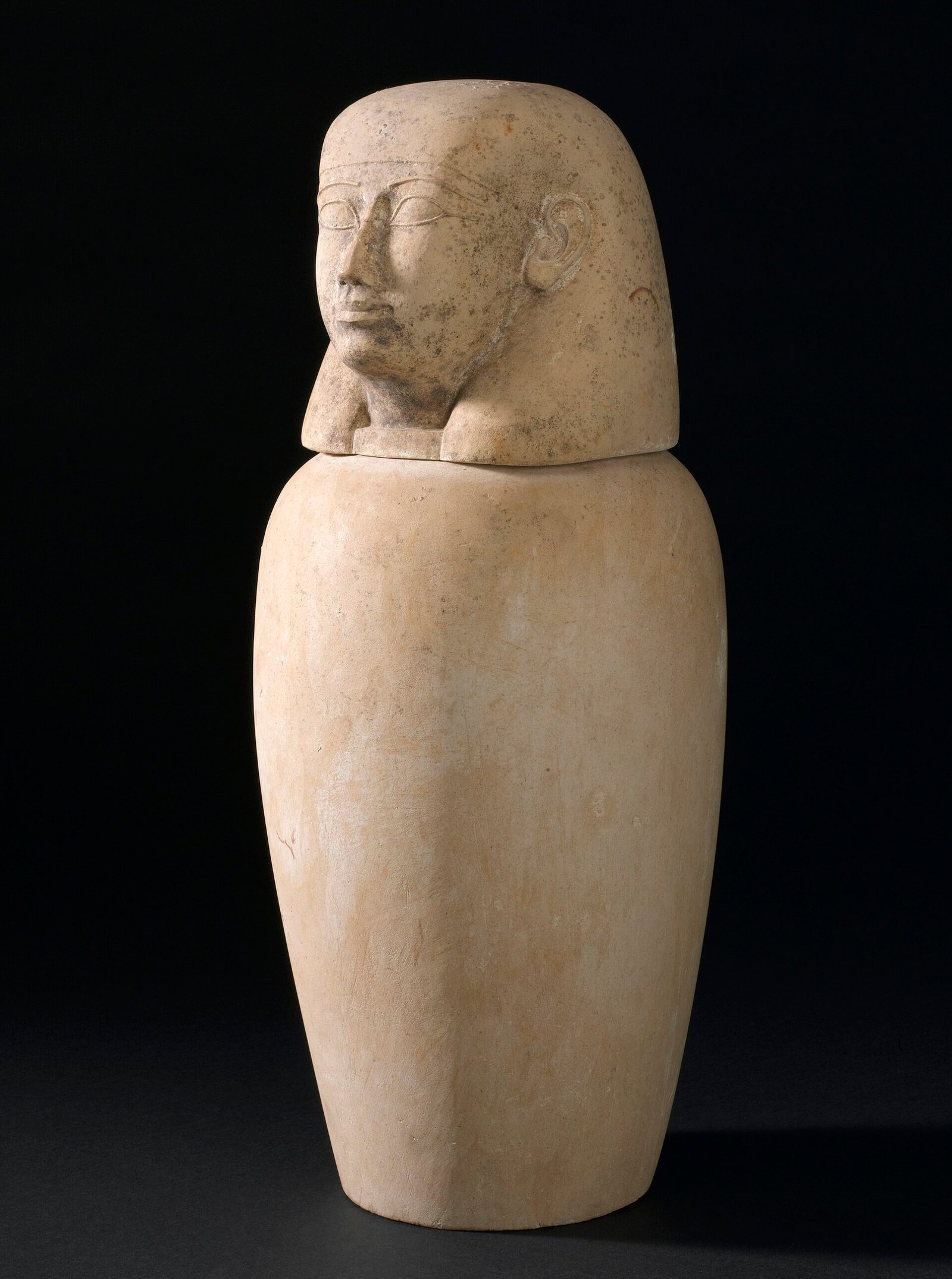
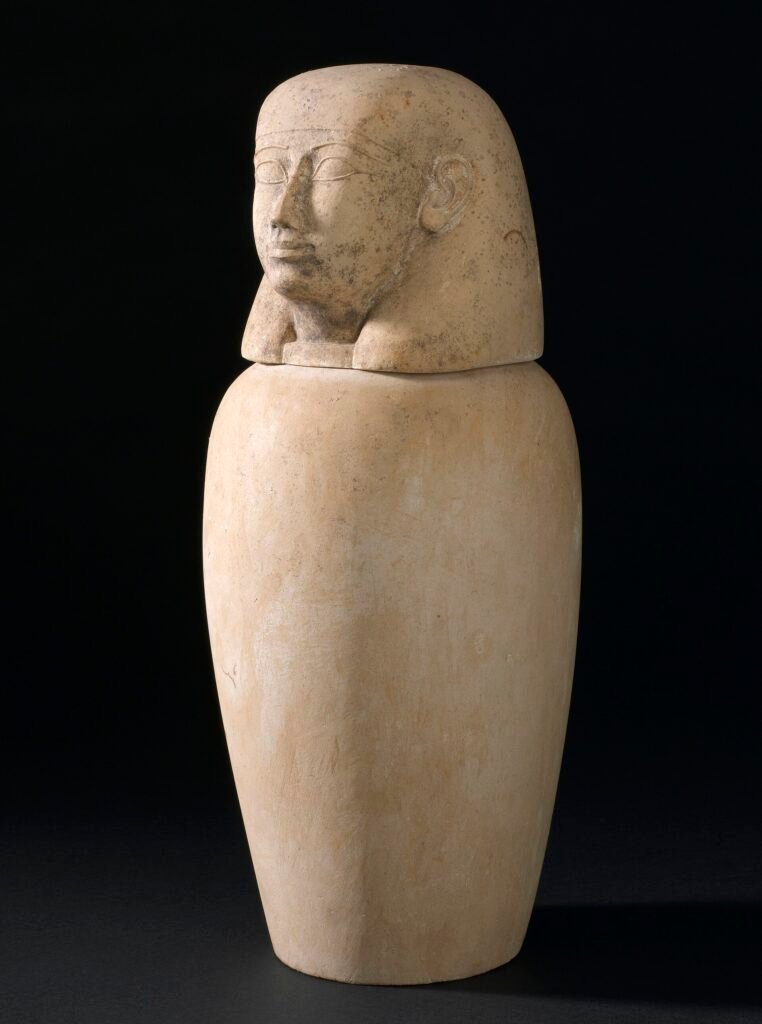
The four organs taken from the body were needed in the afterlife too, so they were embalmed and stored in four jars. From the New Kingdom onward each lid took the head of one of the four sons of Horus, and each son had a goddess standing guard over him.
| Son of Horus | Head | Organ | Guardian goddess |
|---|---|---|---|
| Imsety | Human | Liver | Isis |
| Hapy | Baboon | Lungs | Nephthys |
| Duamutef | Jackal | Stomach | Neith |
| Qebehsenuef | Falcon | Intestines | Serket |
With this table in your head, museums open up. Every canopic set, from plain Middle Kingdom limestone to Tutankhamun's alabaster shrine, follows the same code. In the twenty-first dynasty embalmers began returning the wrapped organs to the body, yet dummy jars were still placed in the tomb because tradition demanded them. Our guide to recognizing the Egyptian gods shows how to tell these four apart on a coffin or a tomb wall.
The heart stays, because it will be weighed
The heart alone was deliberately left in the chest, and if an embalmer removed it by accident he put it back. For the Egyptians the heart, not the brain, was where you thought, remembered and decided, and it had a job to do at the most dangerous moment of the journey.
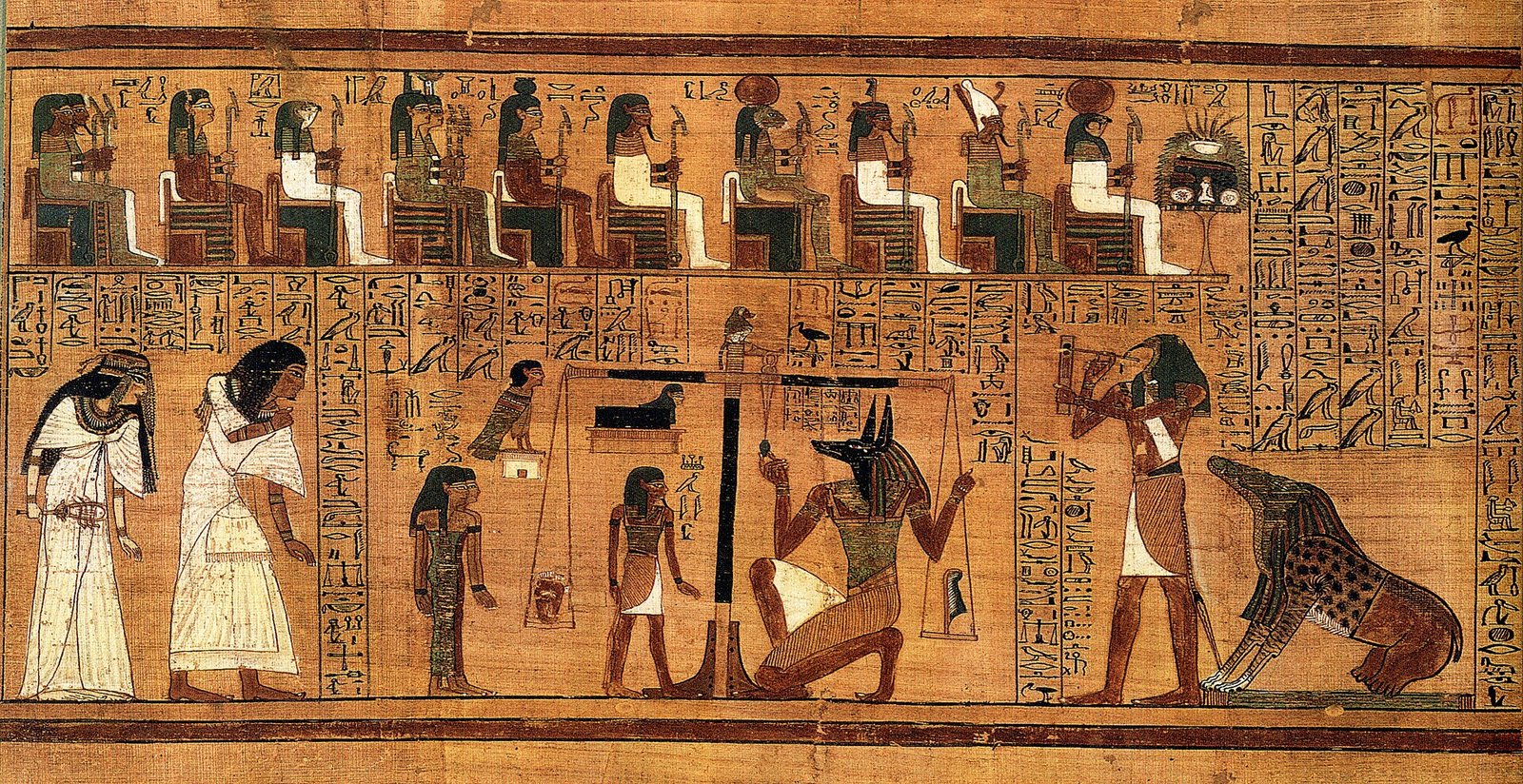
That moment is the weighing of the heart, Spell 125 of the Book of the Dead, painted on countless tomb walls. Anubis, the jackal-headed god of embalming, leads the dead person into the Hall of Two Truths. The heart goes on one pan of the balance, the feather of Maat, goddess of truth, on the other. Thoth records the result while Osiris presides. A light heart passes into the Field of Reeds, an ideal Egypt of endless harvests. A heavy one is eaten by Ammit, part crocodile, part lion, part hippopotamus, crouched beside the scale.
The Egyptians hedged their bets. A green-stone heart scarab went over the heart inside the wrappings, carved with a spell asking it not to testify against its owner. The embalming itself re-enacted what Anubis had done for Osiris, the first mummy, and the chief priest wore a jackal mask to play the part.
Wrapping, amulets and the Book of the Dead
The wrapping was not packaging. It was the longest ritual stage of the process, done by priests reading from a script. Fine new linen was the ideal; in practice families often supplied old sheets and clothing, and some bandages carry laundry marks.
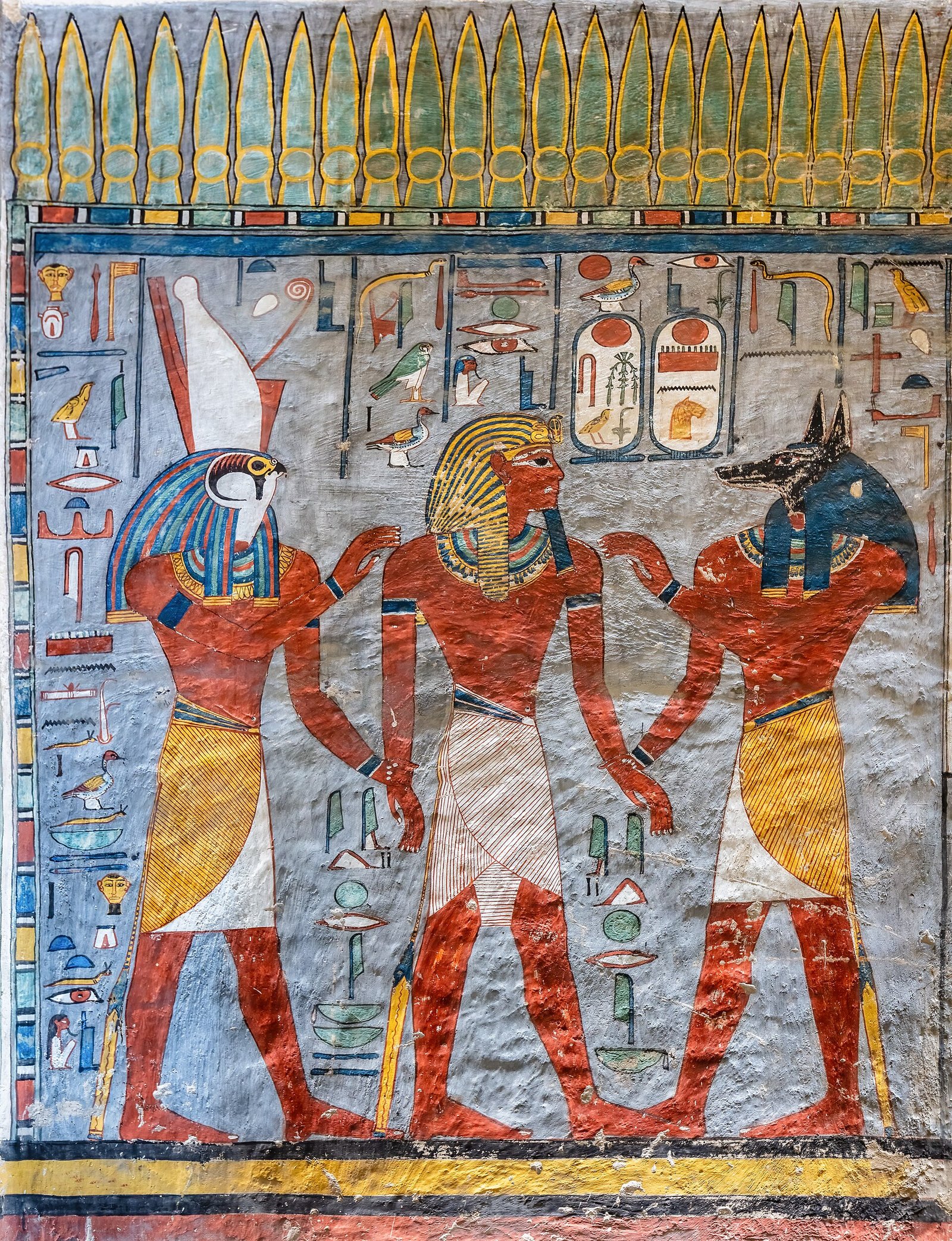
As the strips went on, amulets went in at prescribed places. A headrest amulet under the neck so the head would be lifted in the afterlife. The djed pillar, symbol of stability, along the spine. The red tyet knot of Isis at the throat. Eyes of Horus, scarabs and tiny gods. A rich mummy could hold over a hundred. To name them in a museum case, read our guide to the ankh, scarab and Eye of Horus amulets first.
Inside the wrappings or coffin went the Book of the Dead, a modern title for spells the Egyptians called the Book of Coming Forth by Day. It was a travel guide for the afterlife: passwords for gates, a spell to turn into a falcon, the great confession before Osiris. Finally the mask: solid gold for a king like Tutankhamun, and for most people cartonnage, linen and plaster painted into an ageless face the ba could recognize.
Animal mummies, by the million
The Egyptians mummified animals for four reasons. Pets were buried with their owners. Joints of beef and trussed ducks were embalmed as an eternal picnic. Sacred animals thought to house a god, above all the Apis bull of Memphis, got giant granite sarcophagi in the Serapeum at Saqqara.
The fourth category dwarfs the rest. From the Late Period onward, pilgrims bought a mummified animal as a gift to its god: a cat for Bastet, an ibis for Thoth, a falcon for Horus, a crocodile for Sobek. Temple farms bred them in industrial quantities, and the catacombs at Saqqara hold them by the millions. CT scans show that plenty of those neat bundles hold a few bones or nothing at all, which says something about the priests who sold them.
See them in the animal mummy room of the Egyptian Museum in Tahrir Square and in the bull and ibis galleries at Saqqara.
How mummification changed, from the Old Kingdom to Roman portraits
Mummification was never one fixed technique. It was refined, peaked, declined and went out with a flourish over three thousand years, and the rough sequence lets you read what you are looking at in a gallery.
| Period | What the embalmers did | What to look for |
|---|---|---|
| Old Kingdom | Resin-soaked linen with features modelled outside; organs first removed in the fourth dynasty, as Queen Hetepheres' canopic chest shows. | Linen shells that look like statues |
| Middle Kingdom | Brain removal becomes common, natron drying improves, cartonnage masks. | Rectangular coffins with eyes painted on the side |
| New Kingdom | The golden age. Full evisceration, expert drying, resins, hundreds of amulets, nested coffins. | Ramesses II and Seti I in the Royal Mummies Hall |
| Twenty-first dynasty | Sand and linen packed under the skin for a lifelike shape, painted skin, artificial eyes. | Plump-cheeked priests of Amun |
| Late Period | An industry for everyone who could pay. Heavy resin and bitumen, dummy jars, poor bodies inside fine cases. | Black, brittle mummies in mass-produced coffins |
| Ptolemaic and Roman | The outside matters more than the inside. Geometric bandage patterns with gilded studs, and in the Fayum, painted portraits set into the wrappings. | The Fayum portraits: real faces of people who lived under Rome |
Christianity ended the practice slowly, and the know-how died with the last embalming families.
Where to see mummies in Egypt today
The Royal Mummies Hall, National Museum of Egyptian Civilization, Cairo
This is the one. Twenty kings and queens of the New Kingdom, among them Ramesses II, Seti I, Thutmose III, Hatshepsut and Seqenenre Tao with his battle wounds, lie in a dim, climate-controlled gallery beneath the NMEC in Fustat, shown as they would be in a royal tomb, one to a chamber. Our guide to the National Museum of Egyptian Civilization covers the rest of the building.
The Egyptian Museum, Tahrir Square
The royal mummies have left, but the old museum keeps the animal mummy room, coffins, canopic chests, embalming tools and several non-royal mummies from the priestly caches at Deir el Bahari.
The Grand Egyptian Museum, Giza
The GEM is where you see what went with the body: the Tutankhamun collection, with the gold mask, the nested coffins and the alabaster canopic chest. Our Grand Egyptian Museum guide explains how to sequence it in a day.
The Mummification Museum, Luxor
A small museum on the Luxor corniche that explains the process better than anywhere else: hooks and knives, jars of natron and resin, canopic equipment, animal mummies and the mummy of a high priest of Amun. An hour, ideally before the west bank tombs.
Tombs and burial sites
Tutankhamun is the only pharaoh still lying in his own tomb, in a climate-controlled case in KV62 in the Valley of the Kings, beneath the painted walls he was buried under. At Saqqara, the Serapeum and the recently excavated embalming workshop complete the picture.
The etiquette of looking at a mummy, and what a guide adds
You are looking at a person. Egyptian museums make that point deliberately, and a few habits make the visit better for everyone.
- No photographs in the Royal Mummies Hall. The rule is absolute and enforced. Put the phone away and look.
- Keep your voice low. The hall is built like a tomb. Guides explain outside, then let you walk through in silence.
- Do not lean on the cases. Temperature, humidity and vibration all matter.
- Think about children. Most kids over eight find the mummies fascinating if they know the story first; younger ones can find the dim hall unsettling.
- Skip the jokes. Egyptians are proud of these ancestors. Treat the hall the way you would treat a cathedral.
The labels are short on purpose. What turns twenty quiet cases into the best hour of a trip is the person beside you who can say that the man with the shattered skull is Seqenenre Tao, killed fighting the Hyksos, that the hook-nosed king with white hair is Ramesses II, once issued a passport to fly to Paris for fungus treatment, and that Hatshepsut was identified from a single molar found in a box bearing her name. Explora Egipto works only with licensed Egyptian guides, most of them Egyptology graduates, and if mummification is your thing we send you one who lights up at the question.
How we build it into a Cairo or Luxor day
Mummification fits naturally into days we already run.
The Cairo version
Start at the NMEC in Fustat early, when the Royal Mummies Hall is quietest. Add Coptic Cairo next door, then cross to Giza for the Grand Egyptian Museum in the afternoon, when Tutankhamun's canopic chest makes sense of the morning. With a second day, add Saqqara and Tahrir. It runs as private Cairo excursions with your own guide and driver.
The Luxor version
Take the Mummification Museum first thing, then the west bank: the Valley of the Kings with Tutankhamun in KV62, the tombs of the nobles with their weighing-of-the-heart scenes, and Deir el Bahari, where priests hid the great royal cache. The Luxor excursions page shows how two days fit together; Luxor connects to Cairo by a short domestic flight or a Nile cruise.
Tell us your dates and how deep you want to go, and we send you the quote with the guide already chosen.
Frequently asked questions
Why did the ancient Egyptians mummify their dead?
Because they believed the soul, especially the ba, had to return to a recognizable body each night to survive in the afterlife. A body that rotted meant a second, permanent death. Mummification kept the body intact so the person could live forever. It was an act of hope, not of morbidity.
How long did mummification take?
About seventy days from death to burial. Roughly forty were spent under natron salt, which dried the body completely, and the rest went on removing the organs beforehand and anointing, wrapping and masking afterward. Seventy days also matched the time the star Sirius spends invisible before rising again with the Nile flood.
Why was the heart left inside the mummy?
The Egyptians believed the heart, not the brain, was the seat of thought, memory and conscience. It was needed for the weighing of the heart before Osiris, where it was balanced against the feather of Maat to decide the person's eternal fate. A heart scarab amulet was placed over it to stop it testifying against its owner.
What were canopic jars for?
They held the four organs removed during embalming: the liver, lungs, stomach and intestines, each dried and wrapped separately. Each jar was protected by one of the four sons of Horus, Imsety, Hapy, Duamutef and Qebehsenuef, whose heads appear on the lids from the New Kingdom onward. Later embalmers returned the organs to the body but still placed dummy jars in the tomb.
Where can I see real mummies in Egypt?
The Royal Mummies Hall at the National Museum of Egyptian Civilization in Cairo holds twenty kings and queens, including Ramesses II and Hatshepsut. The Egyptian Museum in Tahrir keeps animal mummies and embalming equipment, the Mummification Museum in Luxor explains the process, and Tutankhamun himself still lies in his tomb in the Valley of the Kings.
Can you take photos of the royal mummies?
No. Photography and filming are prohibited inside the Royal Mummies Hall at the NMEC, and staff enforce it. You can photograph the rest of the museum. The rule protects the mummies from light and keeps the hall feeling like a royal tomb. Most visitors find that not holding a phone makes the visit more memorable.
Look into the face of Ramesses II with someone who can tell you his story
Send us your dates and whether Cairo, Luxor or both are on the table, and we come back with a plan built around the Royal Mummies Hall, the museums and the tombs, with an Egyptologist guide who knows the subject, and the quote in your inbox.